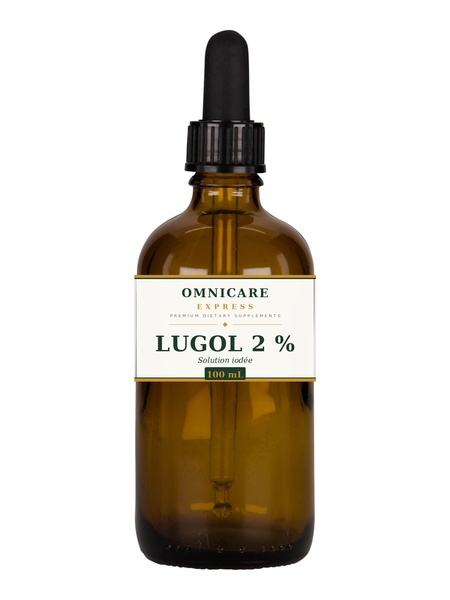
Aqueous iodine solution at 2 % molecular iodine (I₂) and 4 % potassium iodide (KI), commonly known as Lugol's solution. Magistral pharmacy preparation, traditionally used for three distinct purposes: iodine intake by oral route, cutaneous antisepsis, and diluted oral rinse preparations. 100 mL amber glass bottle with dropper cap
About Lugol's solution
Lugol's solution was developed in 1829 by the French physician Jean Guillaume Auguste Lugol (1786-1851), who practised at the Saint-Louis Hospital in Paris and sought a stable, soluble and well-tolerated iodine formulation for his patients. Its formula combines two forms of iodine: molecular iodine (I₂), which is lipophilic, and potassium iodide (KI), which is hydrophilic and also serves to solubilise molecular iodine in water. This combination ensures the stability of the preparation and optimal bioavailability of both ionic forms.
Nearly two centuries later, Lugol's solution remains listed in the European Pharmacopoeia and is among the traditional officinal preparations still widely used in medicine, dentistry, cell biology (Lugol's staining for microscopic observation of starch or cervical cells), and naturopathy.
The present 2 % Lugol's solution (more diluted than the 5 % strong Lugol's) corresponds to the concentration most commonly used in pharmacy compounding for supervised domestic use, offering a higher safety margin while retaining the effectiveness of the original formulation.
Pharmaceutical composition per 100 mL
Component |
Per 100 mL |
Per drop (~0.05 mL) |
Molecular iodine (I₂) |
2.0 g |
≈ 1.0 mg |
Potassium iodide (KI) |
4.0 g |
≈ 2.0 mg |
Purified water (Aqua purificata) |
qs to 100 mL |
qs to 1 drop |
Total elemental iodine intake per drop: approximately 2.5 mg (≈ 2,500 µg). For reference, the nutritional Reference Intake (RI) for iodine in an adult is 150 µg/day: one drop therefore corresponds to a dosage far above the nutritional range, justifying its status as a pharmaceutical preparation rather than a food supplement.
Documented traditional uses
Lugol's 2 % is traditionally used for three distinct purposes, presented below. Each is subject to a specific dosage detailed in the "Dosage and method of administration" section.
1. Internal use — Iodine intake (oral route)
Oral Lugol's has traditionally been used as an iodine supply in specific situations (documented iodine deficiency, pre-surgical thyroid preparation, exposure to certain contaminants). Given its high pharmacological dosage, this use must be strictly supervised by a qualified healthcare professional.
2. External use — Cutaneous antisepsis
Traditional antiseptic solution for the disinfection of small superficial wounds, abrasions, insect bites, or for local application on intact skin. The transient brownish staining it leaves makes the treated area easily identifiable. Broad-spectrum antimicrobial action (bacteria, fungi, viruses) recognised since the 19th century.
3. Use as oral rinse (diluted)
Traditionally used as a dental preparation: 5 to 10 drops diluted in a glass of water for occasional mouthwashes in case of mild oral discomfort. Do not swallow. To be avoided in case of thyroid disorders.
Warnings and precautions for use
• This preparation is intended for supervised use: medical or pharmaceutical advice is essential before any oral use, particularly in case of personal or family history of thyroid disorders.
• Perform a preliminary skin test (apply on the forearm 24 hours before the first extended external use) to check for any iodine allergy.
• Never exceed the recommended doses. In case of overdose, immediately contact the Poison Centre (Luxembourg: 8002 5500; Belgium: 070 245 245).
• Prolonged oral use must be subject to medical follow-up (thyroid panel: TSH, free T4).
Contraindications
This preparation MUST NOT be used in the following situations:
• Known hypersensitivity to iodine or to any of the components (possible cross-reactions with iodinated contrast agents).
• Thyroid dysfunction: hyperthyroidism, Graves' disease, toxic nodular goitre, autonomous thyroid adenoma, Hashimoto's thyroiditis.
• Personal or family history of differentiated thyroid cancer.
• Pregnancy and breastfeeding (crosses the placental barrier and passes into breast milk — risk to the foetal and infant thyroid).
• Children under 12 years of age without formal medical advice.
• Concomitant treatment with amiodarone or other iodinated medications.
• Dermatitis herpetiformis (Duhring-Brocq disease).
• Severe renal insufficiency.
• Active pulmonary tuberculosis.
• Severe acne vulgaris, known acneiform sensitivity to iodine.
Drug interactions
Always inform your doctor or pharmacist of any other concurrent treatment, in particular:
• Synthetic antithyroid drugs (carbimazole, propylthiouracil, methimazole): interference with treatment.
• Amiodarone: cumulative risk of iodine overload and thyroid dysfunction.
• Lithium: potentiation of hypothyroidism risk.
• Potassium salts and potassium-sparing diuretics: risk of hyperkalaemia.
• Iodinated contrast agents (imaging examinations): possible interaction with thyroid investigations (scintigraphy).
• Mercury-based dressings (rare cases): possible formation of an irritant precipitate.
Dosage and method of administration
The dosage depends strictly on the intended use. Do not combine multiple uses simultaneously without professional advice.
Internal use (oral route) — under medical supervision only
As a guideline and under medical supervision: generally 1 drop per day at initiation, to be diluted in a large glass of water or juice, taken with a meal. The dosage may be adjusted by the prescriber according to indication. Do not take on an empty stomach. Do not exceed the prescribed dose.
External use — Cutaneous antisepsis
Apply undiluted, locally with a cotton swab or compress, on the area to be disinfected, 1 to 2 times a day during the period of discomfort. Do not apply to large surfaces or to extensive broken skin. Avoid contact with eyes, mucous membranes, and clothing (stains are persistent).
Use as oral rinse
Dilute 5 to 10 drops in a glass of lukewarm water. Rinse for 30 to 60 seconds, do not swallow, spit out. Maximum 1 to 2 times per day for 3 to 5 days. For occasional use only.
Possible side effects
• Transient brownish staining of skin and mucous membranes after external application (disappears within hours to days depending on the area).
• Transient metallic taste in case of internal use or oral rinse.
• Local skin irritation or allergic reaction (redness, itching): discontinue immediately if these occur.
• Iodism in case of high doses or prolonged use: rhinitis, lacrimation, hypersalivation, headache, acneiform eruption, persistent metallic taste — stop treatment and consult a healthcare professional.
• Digestive disorders (nausea, abdominal pain) by oral route, particularly if taken on an empty stomach.
• Iatrogenic hyper- or hypothyroidism in case of repeated overdosage: consult a doctor promptly in case of signs (palpitations, unexplained weight loss or gain, unusual fatigue, tremors).
Storage
• Store at room temperature, below 25 °C.
• Protected from light (protective amber glass bottle).
• Keep the bottle tightly closed after each use.
• Do not expose to heat or freezing temperatures.
• Keep out of reach and sight of children.
• Storage period after opening: comply with the expiry date indicated on the bottle by the compounding pharmacy — typically 6 months after preparation.
• Do not use after the expiry date.
• In case of any unusual change in colour, appearance or odour, do not use and return the bottle to your pharmacist.
Mandatory mentions
Pharmaceutical form: Aqueous solution for internal and external use
Pharmacopoeia reference: Solutio Lugoli — traditional officinal preparation listed in the European Pharmacopoeia
Quantity: 100 mL amber glass bottle with tamper-evident dropper cap
Important: this magistral preparation is neither a medicinal product with Marketing Authorisation (MA), nor a food supplement. It is prepared at the pharmacy in accordance with Good Compounding Practices. Its use must be supervised by a healthcare professional.
Compounding pharmacy:
MULTIPHARMA MOSSOUX PHILIPPE
Responsible pharmacist: Philippe MOSSOUX
Boulevard Jean de Wilde 4
4000 Liège — Belgium
Telephone: +32 4 226 16 23